


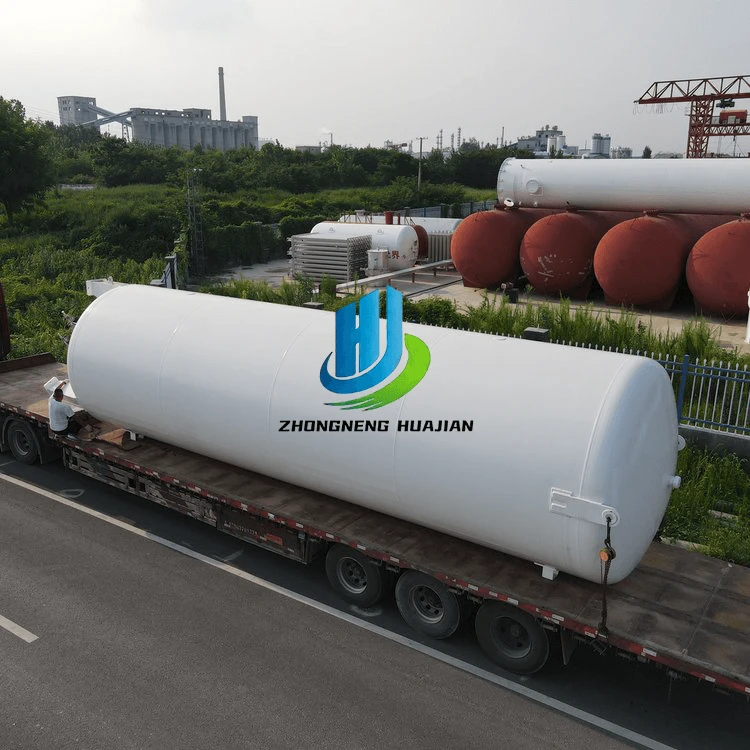


An LCO2 Storage Tank is a pressurized, refrigerated vessel designed to store liquid carbon dioxide at -20°C to -18°C and approximately 20 bar. It is the central distribution hub for CO2 in beverage carbonation, food freezing (dry ice production), water treatment, and greenhouse enrichment, balancing temperature and pressure to maintain the liquid state for on-demand use.
The Friday Crisis: When the Fizz Goes Flat
The crisis hit the brewery on a Friday. Canning line down. The beer was flat. Not a little flat-soda-water flat. The culprit? The massive liquid CO2 tank in the yard was showing pressure, but no liquid was coming out. I got the call as the regional gas guy. "We've got a weekend's worth of IPA turning to shelf turds in the bright tanks," the plant manager said, his voice tight. The problem was a "vapor lock," but not the kind in an engine. The tank's internal "dip tube"-the pipe that draws liquid from the bottom-had somehow drawn in a pocket of warm, gaseous CO2. The system saw pressure and thought it had liquid. It didn't.
Walking a Knife's Edge: The Dual Prison of Pressure and Cold
LCO2 storage is a trickier beast than the cryogenic gases. It doesn't exist as a liquid at atmospheric pressure. It needs to be both cold (around -20°C) and under pressure (about 20 bar, 300 psi) to stay liquid. Your tank isn't just holding it; it's actively maintaining that precise balance on a knife's edge. Most tanks are simple pressure vessels with mechanical refrigeration units wrapped around them, like a giant beer keg in a fridge. The fridge maintains the cold, which in turn maintains the pressure.
Phase Changes and Production Schedules
The devil is in the phase changes. When you draw liquid off to carbonate beer or make dry ice, the tank pressure wants to drop. The fridge kicks in harder. But if you draw too fast, you can "pull a vacuum" on the liquid, causing it to flash into gas and ice (dry ice) inside the pipe, which is exactly what clogs everything. The tank's pumping system has to be precisely matched to the draw rate and the tank's own refrigeration capacity. The brewery's issue was a combination of a high weekend demand and an undersized, aging chiller on their tank. The liquid in the bottom got slightly too warm, formed a gas pocket, and the dip tube found it.

Different Draws, Different Demands
For a food plant that makes dry ice for shipping frozen goods, the tank is a source of liquid to be violently expanded into a solid. Their tanks have heavy-duty, positive displacement pumps that can generate enormous pressure to force the liquid through "dry ice guns." The tanks are built to handle more thermal and pressure cycling stress. For a greenhouse, the tank is a source of CO2 gas to enrich the atmosphere for plant growth. Their system carefully vaporizes the liquid and meters it out. The tank might be smaller, but the controls are precise.
Back at the brewery, the fix was twofold. First, we did an emergency "chill-down" by spraying the tank with water (sounds wrong, but it helps the refrigeration). Second, we installed a new, oversized refrigeration unit the following week. We also added a simple, analog "liquid level" sight glass next to the digital gauge. Sometimes, you just need to see the liquid sloshing. The plant manager now has a rule: if the tank pressure gets above 22 bar, he slows the canning line. It's a manual, but effective, process control.
An LCO2 storage tank is the opposite of "set and forget." It's a dynamic, sweating piece of process equipment. Its job is to walk the line between liquid and gas, between pressure and vacuum, every minute of the day. When it works, you have fizzy beer, frozen salmon, and crisp lettuce. When it stumbles, you have a very expensive, very flat problem.
Technical specification
|
No. |
Specification Model |
Overall Dimensions |
Weight (Kg) |
Remarks |
|
1 |
CFL-5/2.16 |
φ1916 × 5262 |
4800 |
Support |
|
2 |
CFL-10/2.16 |
φ2316 × 5900 |
7000 |
Support |
|
3 |
CFL-15/2.16 |
φ2416 × 7202 |
9600 |
Support |
|
4 |
CFL-20/2.16 |
φ2616 × 7629 |
12000 |
Support |
|
5 |
CFL-30/2.16 |
φ2916 × 8546 |
16700 |
Support |
|
6 |
CFL-40/2.16 |
φ3016 × 10180 |
21200 |
Support |
|
7 |
CFL-50/2.16 |
φ3016 × 12150 |
25200 |
Support |
|
8 |
CFL-60/2.16 |
φ3016 × 14550 |
29200 |
Support |
|
9 |
CFL-80/2.16 |
φ3520 × 13419 |
41900 |
Support |
|
10 |
CFL-100/2.16 |
φ3520 × 16169 |
49700 |
Support |
|
11 |
CFL-150/2.16 |
φ3724 × 21090 |
72400 |
Support |
Hot Tags: lco2 storage tank, China lco2 storage tank manufacturers, suppliers, CO2 industrial tank package


