


Your Professional Cryogenic Storage Tank Supplier!
Zhongneng Huajian Metal Structure Co., Ltd. originated in 2016, initially specializing in the production, design, and installation of storage tanks and pressure vessels. After years of dedicated technical development and industry involvement, the company was officially founded in 2019, launching its own independent R&D and expanding into comprehensive project execution. Our core expertise covers fuel station storage tanks, large-scale chemical tanks, and major oil storage tank projects, accumulating extensive experience in engineering and professional installation.
-
![Custom Pressure Vessel]() Custom Pressure VesselA Custom Pressure Vessel is a one-off engineered container built to exact client specifications for unique pressure, temperature, medium, or process requirements. Unlike standard tanks, these vessels are designed from scratch to solve...view more
Custom Pressure VesselA Custom Pressure Vessel is a one-off engineered container built to exact client specifications for unique pressure, temperature, medium, or process requirements. Unlike standard tanks, these vessels are designed from scratch to solve...view more -
![Large Cryogenic Liquid Storage Tank]() Large Cryogenic Liquid Storage TankA Large Cryogenic Liquid Storage Tank refers to mega-capacity vessels, typically over 100,000 gallons, designed for strategic reserve, production buffer, or major distribution hub duties. These engineering marvels, often field-erected,...view more
Large Cryogenic Liquid Storage TankA Large Cryogenic Liquid Storage Tank refers to mega-capacity vessels, typically over 100,000 gallons, designed for strategic reserve, production buffer, or major distribution hub duties. These engineering marvels, often field-erected,...view more -
![Vertical Cryogenic Liquid Storage Tank]() Vertical Cryogenic Liquid Storage TankVertical Cryogenic Liquid Storage Tank are the industry-standard configuration for large-scale stationary storage of liquefied industrial gases. Their tall, cylindrical shape optimizes footprint, leverages hydrostatic pressure for...view more
Vertical Cryogenic Liquid Storage TankVertical Cryogenic Liquid Storage Tank are the industry-standard configuration for large-scale stationary storage of liquefied industrial gases. Their tall, cylindrical shape optimizes footprint, leverages hydrostatic pressure for...view more -
![Flat Bottom Cryogenic Tank]() Flat Bottom Cryogenic TankA Flat Bottom Cryogenic Tank is a large-capacity, stationary storage vessel with a flat base, designed for the bulk containment of liquefied gases like LN2, LO2, LAr, or LNG at near-atmospheric pressure. Its simple, cost-effective...view more
Flat Bottom Cryogenic TankA Flat Bottom Cryogenic Tank is a large-capacity, stationary storage vessel with a flat base, designed for the bulk containment of liquefied gases like LN2, LO2, LAr, or LNG at near-atmospheric pressure. Its simple, cost-effective...view more -
![High-energy Cutting Gas Tank]() High-energy Cutting Gas TankA High-energy Cutting Gas Tank, specifically an acetylene cylinder, is a specialized fuel container designed for oxy-fuel cutting and welding. Its unique internal construction—a porous mass saturated with acetone—safely stabilizes...view more
High-energy Cutting Gas TankA High-energy Cutting Gas Tank, specifically an acetylene cylinder, is a specialized fuel container designed for oxy-fuel cutting and welding. Its unique internal construction—a porous mass saturated with acetone—safely stabilizes...view more -
![Ethylene Storage Tank]() Ethylene Storage TankAn Ethylene Storage Tank is a cryogenic storage vessel for containing ethylene (C2H4), the essential building block for plastics. Designed to maintain this highly reactive gas in a stable liquid state, it provides vital storage between...view more
Ethylene Storage TankAn Ethylene Storage Tank is a cryogenic storage vessel for containing ethylene (C2H4), the essential building block for plastics. Designed to maintain this highly reactive gas in a stable liquid state, it provides vital storage between...view more -
![Ethane Storage Tank]() Ethane Storage TankAn Ethane Storage Tank is a pressurized, typically refrigerated storage vessel for bulk ethane, a primary feed stock for ethylene production. Acting as a critical buffer between pipeline supply and cracker plant demand, it ensures a...view more
Ethane Storage TankAn Ethane Storage Tank is a pressurized, typically refrigerated storage vessel for bulk ethane, a primary feed stock for ethylene production. Acting as a critical buffer between pipeline supply and cracker plant demand, it ensures a...view more -
![Hydrogen Storage Tank]() Hydrogen Storage TankA Hydrogen Storage Tank is a high-integrity pressure vessel engineered to safely contain hydrogen, either as a high-pressure gas or cryogenic liquid. Addressing unique challenges like hydrogen embrittlement and permeation, it is the...view more
Hydrogen Storage TankA Hydrogen Storage Tank is a high-integrity pressure vessel engineered to safely contain hydrogen, either as a high-pressure gas or cryogenic liquid. Addressing unique challenges like hydrogen embrittlement and permeation, it is the...view more -
![Carbon Dioxide Capture And Storage Tank]() Carbon Dioxide Capture And Storage TankA Carbon Dioxide Capture and Storage Tank is the final containment unit in a CCS (Carbon Capture and Sequestration) or CCU (Utilization) chain. It receives purified, pressurized CO2 from capture systems for temporary storage before...view more
Carbon Dioxide Capture And Storage TankA Carbon Dioxide Capture and Storage Tank is the final containment unit in a CCS (Carbon Capture and Sequestration) or CCU (Utilization) chain. It receives purified, pressurized CO2 from capture systems for temporary storage before...view more -
![LCO2 Storage Tank]() LCO2 Storage TankAn LCO2 Storage Tank is a pressurized, refrigerated vessel designed to store liquid carbon dioxide at -20°C to -18°C and approximately 20 bar. It is the central distribution hub for CO2 in beverage carbonation, food freezing (dry ice...view more
LCO2 Storage TankAn LCO2 Storage Tank is a pressurized, refrigerated vessel designed to store liquid carbon dioxide at -20°C to -18°C and approximately 20 bar. It is the central distribution hub for CO2 in beverage carbonation, food freezing (dry ice...view more -
![Liquid Argon Tank]() Liquid Argon TankA Liquid Argon Tank is a specialized cryogenic vessel for storing and supplying high-purity argon gas. Critical for metal fabrication (TIG/MIG welding), steel making, lighting, and laboratory analytic, these tanks are engineered to...view more
Liquid Argon TankA Liquid Argon Tank is a specialized cryogenic vessel for storing and supplying high-purity argon gas. Critical for metal fabrication (TIG/MIG welding), steel making, lighting, and laboratory analytic, these tanks are engineered to...view more -
![Liquid Nitrogen Tank]() Liquid Nitrogen TankA Liquid Nitrogen Tank is a versatile, cryogenic storage vessel essential for preserving biological samples, enabling industrial processes, and providing inert atmospheres. Designed to safely contain liquid nitrogen at -196°C, these...view more
Liquid Nitrogen TankA Liquid Nitrogen Tank is a versatile, cryogenic storage vessel essential for preserving biological samples, enabling industrial processes, and providing inert atmospheres. Designed to safely contain liquid nitrogen at -196°C, these...view more


Why Choose Us
Advanced Equipment
Our 15,000㎡ production facility is equipped with CNC cutting machines, automated welding systems, plate rolling equipment, and dedicated steel structure production lines. This allows us to support both standard and customized projects with stable production quality and efficient manufacturing control.
Rich Experience
We specialize in storage tanks, pressure vessels, steel structures, and modular fueling systems for industries such as energy, petrochemical, water treatment, and public infrastructure. Our technical team focuses on practical engineering solutions that meet operational, safety, and long-term performance requirements.
Our Certified
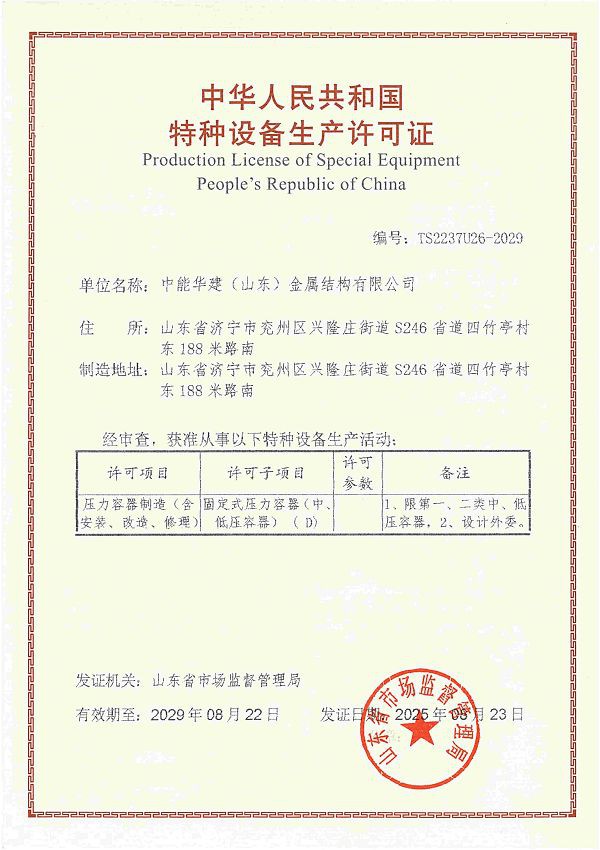
Our operations follow ISO 9001, ISO 14001, and ISO 45001 management standards, supported by industry-required manufacturing and construction licenses. These certifications help ensure product reliability, workplace safety, and compliance with project requirements in energy, chemical, and infrastructure sectors.
One-stop Solution
We provide complete project support from design and engineering to fabrication, on-site installation, and after-sales service. This integrated workflow helps improve project coordination, quality consistency, and delivery efficiency for industrial and infrastructure applications.

Cryogenic tanks are used for the storage of cryogenic liquids. Cryogenic liquids are typically liquefied gases at -153 °C or lower. Common gases include oxygen, argon, nitrogen, hydrogen, and helium. They are stored in specially designed cryogenic storage tanks.
Product Specification
We offers the following product specifications:
|
Item |
Specification |
|
Volume Range |
200 ~ 50000 m³ (Customizable) |
|
Working Pressure Range |
10 ~ 50 kPa (Customizable) |
|
Applicable Media |
Liquid Oxygen (LO₂), Liquid Nitrogen (LN₂), Liquid Argon (LAr), LNG, Liquid Ethylene, etc. |
|
Structural Features |
Vertical cylindrical, double-wall, flat-bottom, dome-roof structure with powder insulation. The tank is mainly composed of an inner tank, an outer tank, and an insulation interlayer. |
Product advantages
Cryogenic liquids
At these ultra-low temperatures, common gases become liquids. Because the vapor pressure is high, the tank must manage both liquid volume and boil-off gases.
Insulation and vacuum jackets
Many cryogenic tanks have a double-wall construction with a vacuum in between, plus insulation, to reduce heat ingress and thus minimize boil-off losses and maintain structural integrity.
Pressure management
Even a well-insulated tank will experience some heat gain, leading to boil-off. The tank must be equipped with pressure-relief valves and possibly a vent system or a reliquefaction path.
Material and construction
Tanks must be designed for low-temperature operation: special steel, proper welds, and ASME or other coding to prevent brittle failure.
Material
|
Component |
Common Material Choices |
Key Properties |
|
Inner Vessel |
Austenitic stainless steel (304, 304L, 316L) |
High toughness at low temperatures, corrosion resistance |
|
Outer Shell |
Carbon steel or stainless steel |
Structural integrity, weather protection |
|
Insulation Layer |
Perlite powder, multi-layer vacuum insulation |
Minimizes heat transfer, maintains low boil-off rate |
|
Piping & Valves |
Stainless steel, brass (for certain gases) |
Leak prevention, compatibility with cryogens |
Application
Medical Fields and Healthcare Sector: Cryogenic tanks store liquid oxygen, providing a continuous and safe gas supply to ventilators in hospitals. They are especially used to provide uninterrupted oxygen supply in intensive care units and operating rooms. Additionally, they offer an ideal environment for storing medical gases in a pure and sterile manner.
Industrial Gas Production: Industrial gases such as nitrogen, oxygen, and argon become liquid under cryogenic conditions. These tanks offer practical solutions for high density storage operations. In fact, these gases wait in tanks before they become ready for use.
Energy and Chemical Industry: Natural gas is converted into its liquid form, LNG, and stored in cryogenic tanks. Vertical or horizontal cryogenic tanks in the chemical industry maintain low temperatures, such as -162°C, minimizing evaporation. The control of the gas phase in reactors directly affects product quality.
Food and Agriculture Industry: Liquid nitrogen is a key component for the instant freezing of food products and preserving their freshness. Cryogenic tanks safely transport these gases to food processing lines.
Aerospace and Aviation Industry: Liquid hydrogen and liquid oxygen used in rocket engines are stored in cryogenic tanks at ultra-low temperatures. This makes it possible to store and transport these high-energy-density fuels in a controlled manner.
Metallurgy and Welding Applications: Inert gases such as argon or nitrogen keep the atmosphere under control in welding operations. Cryogenic tank types provide the preservation and regulation of these gases in production facilities.
Laboratories and R&D Centers: Liquid nitrogen is required in cryogenic freezing processes to preserve biological samples for long periods. Cryogenic storage tanks with appropriate qualities allow for precise experiments with controlled dosing.
Electronics Industry and Semiconductor Production: Cryogenic gases provide ultra-clean environments in the production of electronic equipment and semiconductors. Our range of industrial cryogenic tanks are ideal for cooling equipment or condensing process gases.
Automotive Industry and Hydrogen Energy Applications: Liquid hydrogen for fuel cell vehicles is stored in specialized cryogenic tanks. These tanks are resistant to vibrations and temperature changes in mobile systems. High-vacuum insulation that prevents hydrogen from evaporating preserves energy density.
Schedule routine servicing of PRVs and vent systems to ensure they open at the correct pressures and are free of ice/build-up.
Clean and inspect vent lines. Ice or contamination in vents is a surprisingly common source of pressure build-up.
Re‐test insulation vacuum jackets as recommended by manufacturer or code (depending on design).
Replace gaskets, seals and hoses at intervals appropriate for cryogenic service (not simply standard industrial intervals).
For tanks older than design life or showing signs of wear: consider more frequent inspections, ultrasound testing of materials, or proactive refurbishment.

Other Services
We also provide an extensive range of reinforcement options, such as externally and internally braced tanks, baffle walls, and partition walls. Our insulation options (non-insulated, 1" insulation, 2" insulation) and steel footing choices (pedestal, single beams, skid, flat on slab) cater to diverse needs.
We offer tailored solutions for specific requirements. These include, but are not limited to:
Custom Internal Piping: Tailored internal piping systems to meet the specific plumbing needs of the tank.
Handrails: Safety handrails to ensure safe access and maintenance of the tanks.
Ladder Safety Cages: Protective cages around ladders to prevent falls and enhance safety.
Roof Chambers: Enclosed spaces on the tank roof for various purposes, such as housing equipment.
Side Manways: Side entry points for easy access to the tank interior for inspection and maintenance.
External and Internal Bracing: Additional support structures to enhance the tank’s stability and integrity.
Various Insulation Levels: Insulation options to maintain water temperature and prevent freezing or overheating.
Different Types of Steel Footings: Customized footings to provide a stable and secure foundation for the tanks.
Inspection Hatches: Access points for regular inspection and maintenance without needing to empty the tank.
Ventilation Systems: Systems to ensure proper air circulation and prevent condensation inside the tanks.
Overflow Systems: Mechanisms to handle excess water and prevent spillage.
Certifications




Package & Delivery
Package: Standard export package or Custom
Delivery: By air express, by sea

FAQ
We are one of the most reliable cryogenic storage tank manufacturers and suppliers in China, specialized in providing high quality customized service and EPC service for global clients. We warmly welcome you to wholesale industrial cryogenic storage tank from our factory. Contact us for quotation & pricelist.


