


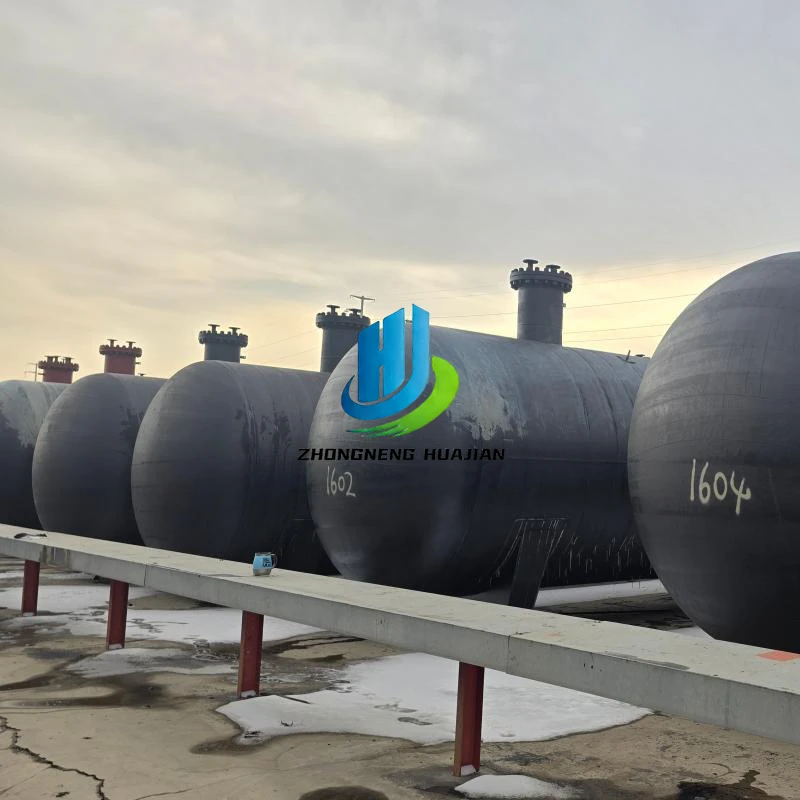

A Custom Pressure Vessel is a one-off engineered container built to exact client specifications for unique pressure, temperature, medium, or process requirements. Unlike standard tanks, these vessels are designed from scratch to solve singular challenges in chemical processing, pharmaceutical manufacturing, energy research, and advanced material production, where off-the-shelf solutions do not exist.
The Blank Canvas: Where the Catalogue Ends
The request didn't come as a purchase order. It arrived as a confidential, 20-page PDF from a biomedical startup. It contained sketches, fluid dynamics simulations, and material compatibility tables. They needed a reactor to synthesize a novel polymer hydrogel under sterile, anaerobic conditions, with precise thermal cycling, internal scraping agitators, and sampling ports that could be sterilized in-place. The operating pressure was modest, but the medium was shear-sensitive and hyper-reactive to trace oxygen. I smiled. This was the realm of the custom pressure vessel. My name is David, and I run the advanced projects shop. Here, there is no part number. There is only a problem, and a conversation.
- The First Month: Translation, Not Engineering
The first phase is never engineering; it's translation. We had weekly calls with their PhD chemists and biologists. "Shear-sensitive" meant we spent days on computational fluid dynamics (CFD) modeling the impeller design to achieve mixing without cell damage. "Anaerobic" meant the entire vessel, from body to the smallest gauge port, had to be capable of being purged with argon and holding an oxygen-free atmosphere, verified by probes. "Sterilize in-place" dictated the use of polished 316L VIM-VAR (vacuum induction melted, vacuum arc remelted) stainless steel for all wetted parts, with orbital tube welding to Ra ≤ 0.4 µm surface finish, and zero dead-legs in all nozzles. Each requirement spun off a subtree of specifications: special packless magnetic drive agitators, dual mechanical seals with a sterile buffer fluid, heated/cooled half-pipe jackets for precise thermal control. The ASME Section VIII, Div. 1 code was our rulebook, but the client's process narrative was our scripture.
- Fabrication as a Symphony of Specialists
Building it is a curated symphony of niche shops. One vendor rolls and welds the pristine shell. Another machines the complex agitator shaft and magnetic drive coupling from a solid block of Hastelloy. A third supplies the specialized, flush-mounted sanitary sight glasses and diaphragm-sealed pressure transmitters. My role is conductor and integrator. I live with spreadsheets of dimensional tolerances, ensuring the flange from Shop A will mate perfectly with the agitator nozzle from Shop B after both have been electropolished. Final assembly happens in our clean tent, under controlled humidity. Every weld is 100% radiographed, then the entire interior is passivated to rebuild the protective oxide layer. The hydrostatic test is a solemn event. We're not just testing for leaks; we're testing the integrity of a hundred interdependent decisions.

The Real Deliverable: The Data Pack
The vessel itself, when it ships, is a stunning piece of functional art. But the physical object is almost secondary. The real deliverable, what the client is truly paying for, is the data pack. The 4-inch-thick binder containing: the ASME U-1 Form and Manufacturer's Data Report, the material certificates traceable to the mill heat and melt, the welding procedure specifications (WPS) and procedure qualification records (PQR), the nondestructive examination (NDE) reports, the passivation and cleanliness validation reports, and the final dimensional as-built drawings. This is the vessel's pedigree, its passport. It proves that this one-of-a-kind object is fit for its one-of-a-kind purpose. The client isn't buying a tank; they're buying the demonstrable certainty that their moonshot process has a home that won't be the reason it fails.
A custom pressure vessel is the antithesis of industrial commodity. It is the physical answer to a question that has never been asked before. It is for the R&D team breaking new ground, for the plant engineer solving a bottleneck unique to their proprietary chemistry, for the visionary who sees a process that doesn't yet have a container. It represents the highest form of collaboration between inventor and fabricator. Its value isn't in its weight or volume, but in its perfect, bespoke alignment with a problem that had, until now, been literally inconceivable. It turns "it can't be done" into a set of engineering drawings.
Technical Parameters
|
Item |
Specification |
|
Design Pressure |
Customizable (0–10.0 MPa) |
|
Design Temperature |
Customizable (-196℃ ~ +500℃) |
|
Volume |
Bespoke, no fixed range |
|
Applicable Media |
Shear sensitive fluids, reactive media, anaerobic/sterile process fluids |
|
Main Material |
316L VIM VAR stainless steel; Hastelloy optional |
|
Surface Finish |
Ra ≤ 0.4 μm (electropolished & passivated) |
|
Welding Standard |
Orbital tube welding; 100% radiographic inspection (RT) |
|
Structure Features |
Zero dead legs; sanitary design; sterile in place capability |
|
Agitator System |
Packless magnetic drive; dual mechanical seals; low shear impeller |
|
Jacket Type |
Half pipe jacket for heating / cooling |
|
Auxiliary Ports |
Sterile sampling ports; sanitary sight glasses; diaphragm pressure transmitters |
|
Atmosphere Control |
Full argon purge; oxygen free environment monitoring |
|
Testing Items |
Hydrostatic test; passivation test; cleanliness validation; NDE |
|
Delivery Package |
Complete data pack (U 1 Form, MDR, material certs, WPS/PQR, NDE reports, as built drawings) |
Hot Tags: custom pressure vessel, China custom pressure vessel manufacturers, suppliers, custom process storage tank


