Managing Thermal Stability and Preventing Caustic Embrittlement
Let's be realistic. Anyone who has spent years on chemical sites, pulp mills, or wastewater plants knows that 50% concentrated sodium hydroxide (NaOH) is a brutal fluid to manage. Desk-bound procurement teams and new graduates often just look up a standard manual, buy a generic carbon steel tank, and hook it up. Then, two or three years later-or during a winter maintenance turnaround-they are left with a frozen solid tank base, blown pump impellers, or micro-cracks along the weld seams due to caustic embrittlement (intergranular stress corrosion cracking).
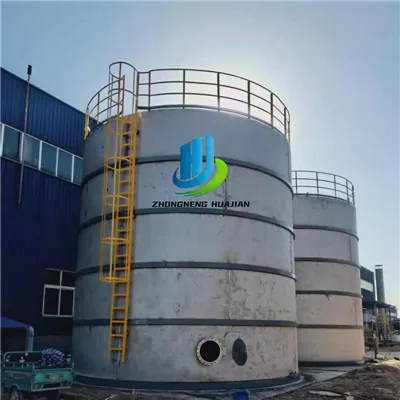
At Zhongneng Huajian (Shandong) Metal Structure, we build Liquid Caustic Soda Storage Tanks for engineers who know that generic fabricators don't understand chemical physics. We design systems that handle temperature fluctuations, protect chemical purity, and keep your site compliant with environmental safety regulations under real-world operating extremes.
Material Selection for Chemical Compatibility
| Material | Recommended Use | Key Properties |
| Carbon Steel | Concentrated NaOH at ambient temperature; most economical | Forms protective passive layer; durable for bulk storage |
| Stainless Steel (304/316L) | Hot caustic, high-purity, or food-grade applications | Excellent corrosion resistance, cleanable, maintains product quality |
| High-Density Polyethylene (HDPE) | Lower concentration, mobile or transport applications | Lightweight, chemically inert, resistant to stress cracking |
The Jiangsu Paper Mill Lesson: Why 100% RT Clearance Didn't Stop the Welds from Cracking
A few seasons ago, we executed a rapid replacement of a 50% caustic storage tank for a major paper mill in Jiangsu. Their original fabricator provided full 100% radiographic testing (RT) reports showing perfect weld compliance. Yet, within 26 months of operation, white salt-out crusts began weeping around the main structural seams. The steel's grain boundaries had completely failed.
- The Root Cause: Unrelieved residual welding stress. When we fabricate concentrated alkali vessels, Post-Weld Heat Treatment (PWHT) is a mandatory engineering directive, not an optional line item. We place the entire welded tank into a controlled stress-relieving furnace, holding the temperature strictly according to wall thickness (typically 1 hour per 25mm of thickness) and verifying that the heat-affected zone (HAZ) hardness drops below HB200. Without this thermal stress relief, once your process fluid ticks past 40°C, the caustic solution acts like a wedge, splitting the micro-structures along the weld.
- Iron Contamination Thresholds: If you are running a food-grade Clean-in-Place (CIP) system, pharmaceutical processing, or high-end papermaking, carbon steel's micro-leaching will ruin an entire product batch. For these applications, we switch exclusively to 304 or 316L stainless steel, executing mechanical polishing followed by chemical passivation to ensure an internal surface roughness ($\text{R}_\text{a}$) below 0.4μm. This eliminates microscopic anchoring points where caustic crystals can bind.
Handling a -15°C Winter Shutdown: The Reality of the 28°C Window
Concentrated 50% caustic soda begins to freeze and crystallize rapidly between 12°C and 15°C. For facilities operating in regions with severe winter drops or heavy diurnal temperature swings, a 48-hour power outage or plant turnaround can paralyze the entire transfer network. We don't make empty marketing promises about "completely eliminating freeze risks." Instead, we engineer strict thermodynamic barriers:
- Dual-Layer Insulation: We reject thin, cheap insulation wraps. The tank shell receives a dual-layer, staggered-joint 50mm high-density rock wool (or field-foamed polyurethane) insulation barrier, jacketed in a 1.0mm embossed aluminum sheet to lock in thermal energy and minimize hourly BTU losses.
- The Narrow "Safety Window": Our smart heat-tracing loops don't just monitor a single point; sensors are arrayed across the bottom cone, sidewalls, and discharge nozzles. We program the automation to hold the bulk chemical strictly at 28°C ± 3°C. Why this exact window? Any higher, and you dramatically accelerate the carbon steel caustic embrittlement clock. Any lower, fluid viscosity spikes, risking localized crystallization and severe pump cavitation. In engineering, every degree is a calculated compromise.
Dealing with $\text{CO}_2$ Crusts: Mechanical Adjustments That Save Your Maintenance Crew
If your transfer pumps are constantly choking on white, chalky blockages, it's rarely a chemical quality issue. It means your tank's conservation vent is drawing in ambient air, allowing atmospheric carbon dioxide ($\text{CO}_2$) to react with the NaOH to form sodium carbonate precipitates.
- Isolating the Chemistry: For high-purity processes, we isolate the vapor space with a low-pressure nitrogen blanketing loop operating at a micro-positive pressure of 0.5 kPa to 1.0 kPa, completely sealing the liquid surface from air and moisture.
- Conical Drainage vs. Flat Bottoms: We never build flat-bottom tanks for caustic service. We enforce a minimum 1:10 sloped or conical bottom profile tied to a dedicated low-point sump. During annual maintenance turnarounds, your crew can flush the interior with a high-pressure water gun from the manway. The residual alkali sludge drains out in minutes, meaning nobody has to risk entering the vessel to manually scrape off skin-burning scale.
Forget the "20kV Blanket Test" Myth: Real Quality Verification
Many industrial brochures claim "20kV high-voltage spark testing across every square inch of internal lining." Any experienced NDE inspector knows that blindly cranking the voltage that high will punch holes through thin coatings, while low voltage misses pinholes entirely.
- Calibrated Holiday Detection: For internally lined configurations (such as epoxy vinyl ester resin linings), we map the actual dry film thickness (DFT) with a magnetic gauge. We then calibrate the holiday detector precisely to 4kV per 1mm of lining thickness-meaning a 2.0mm lining is scanned uniformly at 8kV with a brass brush probe moving at roughly 0.2 meters per second.
- The Final Quality Dossier: When we hand over the asset, your project team receives a comprehensive Quality Control Dossier: mill test reports (MTRs) traceable to every plate heat number, full RT weld logs, welder qualification records, and a 24-hour hydrostatic chart chart-recorded under pressure. This ensures your EPC contractor or regulatory auditors can close out compliance checks without a single hitch.
Let's Look at Your Actual Nozzle Orientation and Foundation Loads
Every chemical plant layout introduces different constraints-whether it's pipeline alignment, anchor loading limits, or specific nozzle configurations. Generic procurement templates won't catch an alignment conflict before the concrete foundation is poured.
Skip the formal, slow corporate inquiries. Send your current CAD drafts, chemical purity targets, or localized climate profiles directly to our technical interface, Fengdan, at sales.cehuajian@gmail.com. Our engineering workshop will review your layouts to calculate nozzle stresses and structural options, offering a practical blueprint built for your actual site conditions.
Hot Tags: liquid caustic soda storage tank, China liquid caustic soda storage tank manufacturers, suppliers, Polypropylene Chemical Storage Tanks, Waste Acid Storage Tank, Alcohol Storage Tanks, chemical storage tanks, Acid and Alkali Storage Tanks, Corrosion resistant Chemical Storage Tanks