


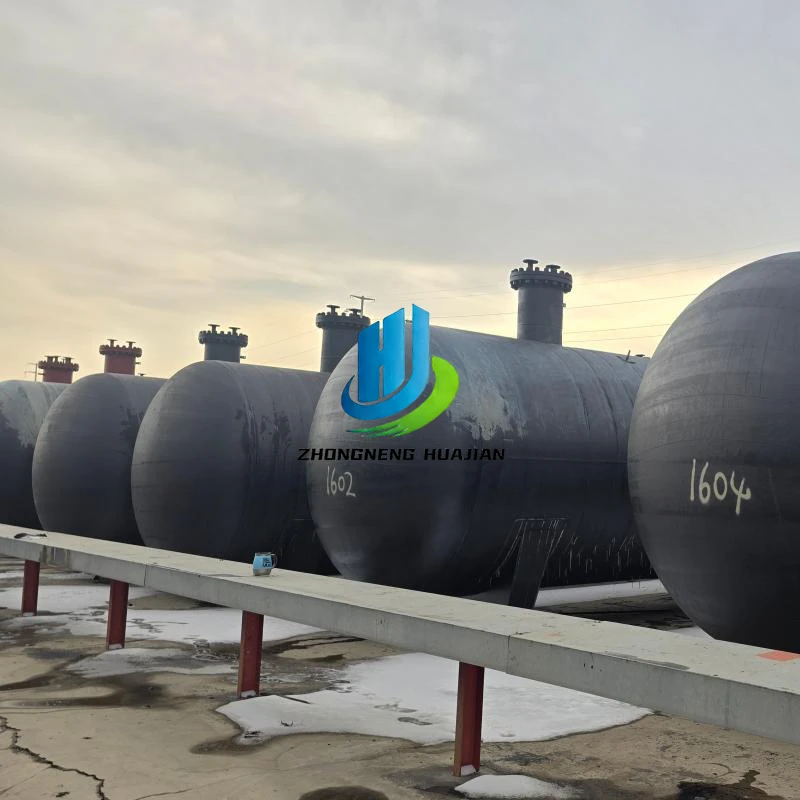
 A vertical tank is only as straight as its foundation. The shell, coating and nozzles can be perfect in the shop, and a 25 mm settlement differential on site will buckle the bottom course or tear the roof-to-shell joint. Zhongneng Huajian reviews the foundation drawing before the concrete is poured, because correcting a ring beam after hydrotest is a demolition job.
Ring beam or full raft?
Up to about 20 m diameter on good soil (bearing >150 kPa), a reinforced concrete ring beam with interior sand or granular cushion is standard-economical and easy to level. Above 20 m, or on soft/compressible soil, a full raft slab is the safer choice. On reclaimed land or mangrove fill, preloading or deep mixing may be needed before the beam is cast.
Key design checks
Soil bearing capacity and settlement estimate under full hydrostatic load
Differential settlement: typically limited to 12–25 mm across the diameter for large tanks
Annular plate bearing pressure and any necessary bottom stiffening
Anchor bolt circle vs shell course: bolts must align to within 5 mm or shells will not seat
Drainage slope away from the tank edge to keep the ring beam dry
What goes wrong
Shell rocked on a high spot → vertical seam opens during hydrotest
Center settles more than edge → bottom plate tears at the lap weld
Beam cast out of round → shell course jacking takes hours and still leaves a lean
Water ponding against the shell → underside corrosion and coating failure
The preload option
On soft soil, ZN sometimes recommends a soil preload using a temporary water fill or fill mound for 2–4 weeks before tank erection. It costs time up front and saves a settlement rebuild later. For the 66 m diameter Dammam water tanks, the owner-engineer's foundation design was reviewed jointly before shell courses arrived on site.

FAQ snippet
"Who is responsible for the foundation-tank supplier or EPC?" Contract-dependent. ZN can supply a reviewed foundation drawing and supervise, or deliver full turnkey including civil works via its Class II construction license. The critical point is that the tank and foundation designs are coordinated in one register.
A tank foundation is not a generic concrete pad; it is a structural element carrying a moving, heavy liquid load, and it deserves the same engineering attention as the shell above it.


